
What Is Car Compound and Polish? Differences Between Cutting Compound and Wax
Vehicle paint can lose gloss over time due to sunlight, improper washing, road contamination, bird droppings, resin and environmental exposure.
Fine scratches, swirl marks and oxidation can also develop on the clear coat.
One of the most common methods for restoring the appearance of automotive paint is paint correction using compound, polish and wax.
However, compound and wax are not the same product.
A compound is generally used to correct surface defects, while wax is used mainly to improve gloss and add a protective layer.
What Is Car Compound and Polish?
Car polishing is a process used to improve the appearance of automotive paint by reducing surface defects and restoring gloss.
A typical process may involve:
Cutting compound
Finishing polish
Wax or paint protection
Different products are selected according to the condition of the paint.
What Is Cutting Compound?
A cutting compound is an abrasive product designed to remove or reduce defects from the clear coat.
It may help correct:
Light scratches
Moderate scratches
Oxidation
Sanding marks
Water spots
Swirl marks
Dull paint
The abrasive particles remove a microscopic amount of the clear coat and level the surface.
What Is Car Polish?
Car polish is generally less aggressive than heavy cutting compound.
It is commonly used for:
Fine scratches
Swirl marks
Holograms
Finishing
Gloss enhancement
A finishing polish can refine the surface after a more aggressive compound.
What Is Car Wax?
Car wax is a protective and gloss-enhancing product applied after polishing.
Wax can:
Increase gloss
Improve surface slickness
Enhance color depth
Provide light environmental protection
Improve water behavior
Wax does not normally remove deep scratches.
Compound vs Polish vs Wax
Compound
Higher abrasive power
Corrects more significant defects
Removes oxidation and sanding marks
Used during paint correction
Polish
Lower abrasive power
Refines the finish
Removes light swirls and holograms
Improves gloss
Wax
Adds gloss
Provides surface protection
Improves water repellency
Does not significantly correct scratches
In simple terms:
Compound corrects, polish refines, wax protects and enhances.
Does Compound Remove Scratches?
It depends on scratch depth.
Light Clear-Coat Scratches
These may often be significantly reduced or removed through polishing.
Moderate Scratches
These may improve but may not disappear completely.
Scratches Reaching the Color Coat
Compound will not restore missing paint.
Touch-up paint or refinishing may be required.
Scratches Reaching Bare Metal
These require body and paint repair rather than polishing.
What Are Swirl Marks?
Swirl marks are fine circular scratches visible under direct light.
They are commonly caused by:
Automatic brush washes
Dirty wash mitts
Dry wiping
Poor drying techniques
Contaminated towels
Washing dusty surfaces
What Is a Swirl Remover?
A swirl remover is a fine abrasive polish designed to reduce:
Fine scratches
Swirls
Holograms
Light polishing marks
It is often used during the finishing stage.
What Are Holograms?
Holograms are wave-like polishing marks visible under strong light.
They can be caused by:
Aggressive compounds
Incorrect polishing pads
Rotary machine misuse
Excessive speed
Poor finishing technique
A finishing polish can help remove them.
What Is Heavy Cutting Compound?
Heavy cutting compound has stronger abrasive performance.
It may be used for:
Sanding marks
Heavy oxidation
Deeper clear-coat scratches
Severe paint defects
Because it removes more material, it must be used carefully.
What Is Finishing Polish?
Finishing polish uses fine abrasives to improve the final surface.
It can:
Remove light haze
Remove holograms
Improve gloss
Refine previous compound marks
How Is Paint Correction Performed?
1. Wash the Vehicle
The vehicle should be thoroughly cleaned.
Remove:
Dust
Mud
Road grime
Insect residue
Bird droppings
2. Decontaminate the Paint
Bonded contaminants such as:
Iron particles
Tar
Resin
Industrial fallout
should be removed.
3. Inspect the Paint
Use suitable lighting to identify:
Scratches
Swirls
Oxidation
Holograms
Paint thickness measurement may also be useful.
4. Select the Correct Compound
Depending on the paint condition, choose:
Heavy cutting compound
Medium compound
Fine polish
Finishing polish
The least aggressive effective combination should generally be selected.
5. Select the Correct Pad
Polishing pads can include:
Cutting pads
Medium pads
Finishing pads
The pad and compound should be matched to the paint condition.
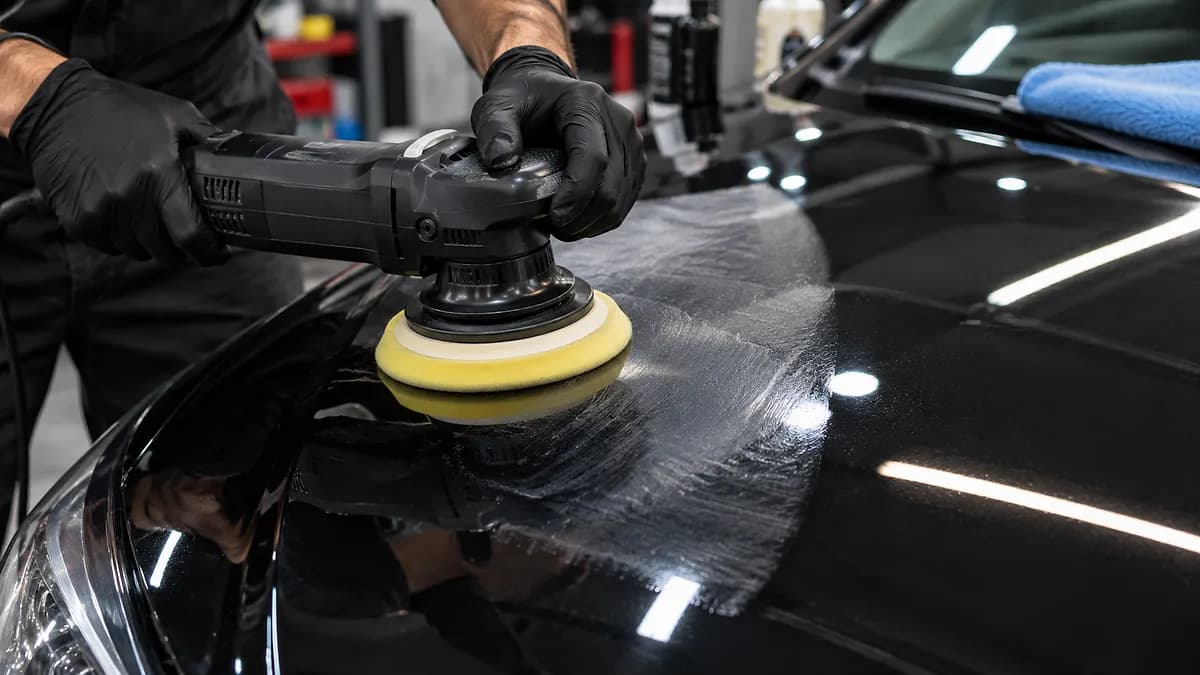
6. Polish the Surface
Work in small sections using controlled machine movement.
Avoid keeping the machine in one area for too long, as excess heat can build up.
7. Inspect the Surface
Remove residue and inspect under proper lighting.
Further refining may be required.
8. Apply Finishing Polish
A finishing stage can remove fine haze and holograms left by heavier correction.
9. Apply Wax or Protection
After correction, the surface can be protected with:
Wax
Sealant
Ceramic coating
Paint protection products
Can Car Polishing Be Done by Hand?
Yes, light applications can be performed by hand.
Hand polishing may be suitable for:
Small areas
Light oxidation
Minor defects
Machine polishing is usually more effective for full paint correction.
What Is a Polishing Machine?
A polishing machine is an electric tool used to apply compounds and polishes more consistently.
Common types include:
Rotary polishers
Dual-action polishers
Orbital polishers
What Is a Rotary Polisher?
A rotary machine rotates on a single axis.
It offers strong correction capability.
Incorrect use may increase the risk of:
Holograms
Excessive heat
Clear-coat damage
What Is a Dual-Action Polisher?
A dual-action polisher combines rotation with orbital movement.
This can make it more forgiving and reduce concentrated heat.
It is commonly preferred for controlled paint correction.
Does Polishing Remove Clear Coat?
Yes.
Abrasive polishing removes a microscopic amount of clear coat.
Correct polishing removes only the amount necessary to level surface defects.
Repeated aggressive correction should be avoided.
Can Polishing Damage Paint?
Incorrect technique can damage the finish.
Risk factors include:
Aggressive compound
Wrong pad
Excessive machine speed
Too much pressure
Long working time in one area
Thin clear coat
How Often Should a Car Be Polished?
There is no fixed schedule.
Heavy paint correction should be performed only when necessary.
Wax and non-abrasive protection can be applied more frequently according to the product.
Can Polishing Fix Sun Damage?
Light oxidation may improve significantly.
However, polishing cannot repair clear coat that is:
Peeling
Cracking
Severely burned
Structurally damaged
Refinishing may be necessary.
Can Polishing Restore Dull Paint?
If the dullness is caused by light oxidation and surface defects, polishing can greatly improve the finish.
Severely failed paint may require repainting.
Can Polishing Remove Water Spots?
Light mineral deposits may be corrected with polishing.
Severe water spotting can etch into the clear coat and require stronger correction.
Can Polishing Remove Bird Dropping Marks?
Superficial etching may improve.
Deep chemical damage can permanently affect the clear coat.
Bird droppings should therefore be removed as quickly as possible.
Polishing Black Cars
Black paint shows swirl marks and holograms very clearly.
Careful pad selection and finishing are particularly important.
Polishing White Cars
White paint hides some fine swirls but can clearly show:
Iron contamination
Road grime
Yellowing
Oxidation
Decontamination is especially important.
Can Metallic Paint Be Polished?
Yes.
Metallic pigments are generally beneath the clear coat.
Polishing is performed on the clear-coat surface.
Should a New Car Be Polished?
A new vehicle in good condition may not need abrasive polishing.
If transport or dealership preparation has created light swirls, a fine finishing polish may be sufficient.
What Is Clay Bar Treatment?
Clay bar treatment removes bonded contamination from the paint surface.
It can help remove:
Industrial fallout
Embedded particles
Surface contamination
Claying is often performed before machine polishing.
Should Paint Protection Be Applied After Polishing?
Yes.
After paint correction, the clean surface is suitable for a protective layer such as:
Wax
Sealant
Ceramic coating
Is Paint Correction the Same as Paint Protection?
No.
Paint correction removes or reduces defects.
Paint protection creates a protective layer over the corrected finish.
They are complementary processes.
Common Paint Correction Mistakes
Polishing a Dirty Vehicle
Contamination can create new scratches.
Using Too Much Compound
More product does not necessarily mean better correction.
Using the Wrong Pad
An unnecessarily aggressive pad can remove too much material.
Excessive Machine Speed
High speed can create heat and surface defects.
Trying to Correct Everything with One Product
Different defects require different levels of abrasiveness.
Failing to Inspect the Surface
Product oils can temporarily hide defects.
How Do You Choose a Compound or Polish?
Consider:
Paint condition
Scratch depth
Clear-coat hardness
Machine type
Pad type
Required cutting power
Desired finish
User experience
What Is One-Step Polishing?
One-step products aim to provide both moderate correction and gloss in a single stage.
They can be useful for vehicles with light to moderate defects.
What Is Two-Step Paint Correction?
A two-step process commonly includes:
Cutting compound
Finishing polish
The first stage corrects defects, while the second refines gloss and removes haze.
What Is Three-Step Paint Correction?
For severely damaged finishes, a process may include:
Heavy correction
Medium polishing
Finishing polish
Not every vehicle requires three stages.
Frequently Asked Questions
What is car compound and polish?
It is a paint correction process used to reduce surface defects and restore gloss.
Is compound the same as wax?
No. Compound is abrasive and corrects defects. Wax mainly adds gloss and protection.
Can compound remove scratches?
It can reduce light and moderate clear-coat scratches. Deep scratches require paint repair.
Does wax remove scratches?
Standard wax does not remove deep scratches.
What is a swirl remover?
It is a fine polish used to remove light swirl marks and holograms.
Can polishing be done by hand?
Yes, but machine polishing provides more consistent results for larger areas.
Does polishing thin the clear coat?
Yes, abrasive polishing removes a microscopic amount of clear coat.
Can polishing repair sun-damaged paint?
It can improve light oxidation but cannot repair failed or peeling clear coat.
Should wax be applied after polishing?
Yes, wax or another protection product can be applied after correction.
Does a new car need polishing?
Not necessarily. Light finishing polish may be used only if defects are present.
Conclusion
Car compound, polish and wax perform different functions in automotive paint care.
Compound is used to correct scratches, oxidation and paint defects.
Polish refines the finish and improves gloss.
Wax adds gloss and surface protection.
A proper process includes:
Thorough washing
Surface decontamination
Paint inspection
Correct compound selection
Appropriate polishing pad
Controlled machine polishing
Finishing polish when required
Final paint protection
Using the least aggressive method necessary helps preserve the clear coat while improving the appearance of the vehicle.