
How to Use Automotive Spray Paint? Application Guide for a Professional Finish
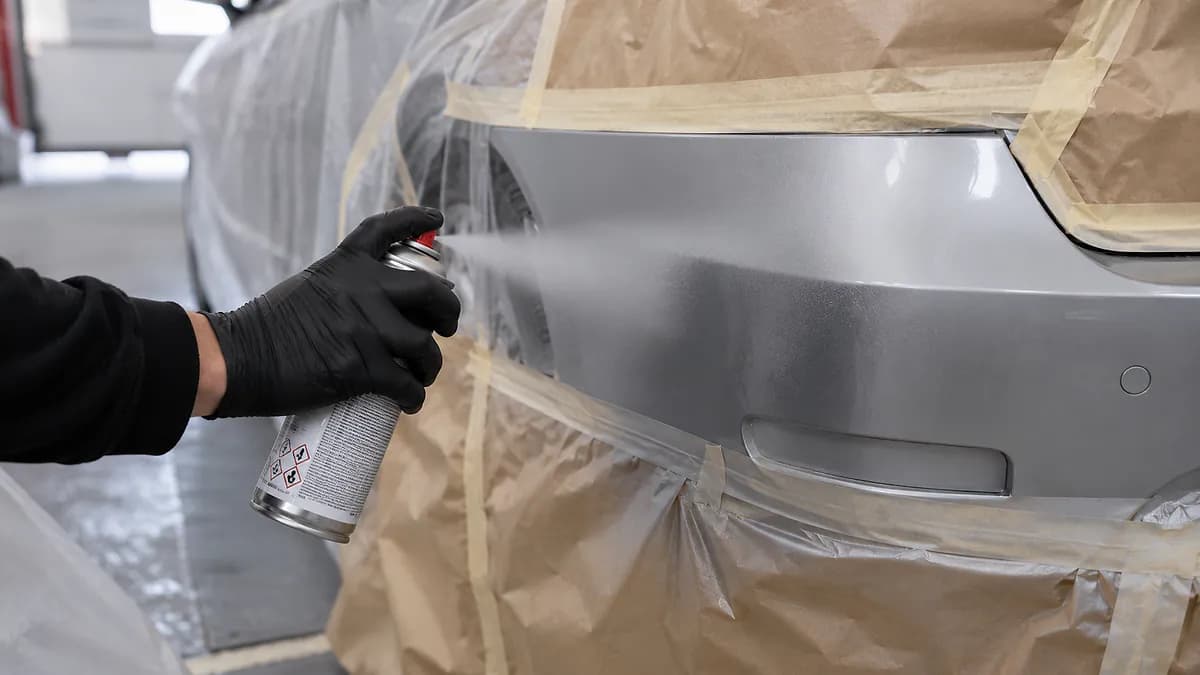
Automotive spray paint provides a practical refinishing option for small and medium-sized vehicle repairs.
It can be used for localized paint damage, bumpers, wheels, mirror covers, small body parts and various cosmetic repairs.
However, achieving a good finish requires more than simply shaking the can and spraying the surface.
Surface preparation, primer selection, spray distance, coat thickness, flash time and clear-coat application all affect the final result.
When the goal is to match the original vehicle color, automotive spray paint prepared according to the vehicle paint code is preferable to a generic color.
What Is Automotive Spray Paint?
Automotive spray paint is a coating supplied in a pressurized aerosol container for vehicle refinishing applications.
The paint is atomized through a nozzle, allowing the user to apply a coating without a conventional spray gun and compressor.
Common applications include:
Local paint repairs
Small body parts
Bumper sections
Mirror covers
Wheels
Plastic components
Small scratches
Localized paint loss
Is Automotive Spray Paint the Same as Regular Spray Paint?
No.
General-purpose spray paint may be designed for:
Furniture
Hobby projects
Decorative metal
Wood
Household surfaces
Automotive spray paint is designed for vehicle refinishing systems and may offer compatibility with automotive primers, clear coats and factory color formulas.
Why Is the Vehicle Paint Code Important?
A vehicle may have several shades that look similar but use different factory paint formulas.
A manufacturer may offer several versions of white, grey, black or blue.
For this reason, accurate automotive refinishing should use the factory vehicle paint code whenever possible.
Preparing the Surface
Surface preparation is one of the most important parts of any paint application.
The surface should be free from:
Dirt
Oil
Wax
Silicone
Dust
Road contamination
Poor preparation can cause adhesion and finish problems.
Sanding Before Spray Painting
Sanding may be required to:
Remove surface defects
Dull an existing glossy finish
Prepare repaired areas
Improve coating adhesion
Smooth transition areas
The correct abrasive grade depends on the repair process.
Masking
Protect surrounding areas using:
Masking tape
Masking paper
Protective film
Windows, lights, tires, trims and adjacent body panels should be protected from overspray.
Is Primer Necessary Before Automotive Spray Paint?
Primer requirements depend on the surface.
Primer may be necessary on:
Bare metal
Body filler
Repaired areas
Bare plastic
Surfaces where the original coating has been removed
The correct primer helps improve adhesion and surface uniformity.
Preparing the Aerosol Can
Shake the can thoroughly before use.
Automotive paint pigments can settle during storage.
The internal mixing ball helps redistribute the pigment when the can is shaken.
Follow the mixing time stated on the product label.
What Is the Correct Spray Distance?
The correct distance depends on the aerosol system.
Spraying too close may cause:
Runs
Sagging
Excessive paint build
Spraying too far away may result in:
Dry spray
Rough finish
Poor coverage
Many aerosol products are applied from approximately 20–30 cm, but the manufacturer's instructions should always take priority.
How Should Spray Paint Be Applied?
Keep the aerosol moving across the surface at a consistent speed.
Start the spray slightly outside the panel, move across the surface and stop after passing the opposite edge.
This can reduce heavy paint build-up at the beginning and end of each pass.
How Many Coats Are Required?
There is no universal number.
The required coats depend on:
Color
Hiding power
Substrate color
Surface condition
Paint system
Several controlled coats are generally preferable to one heavy coat.
How Long Should You Wait Between Coats?
The required flash time varies according to the product.
Applying the next coat too soon may cause:
Runs
Solvent trapping
Surface defects
Always follow the product instructions.
How Can You Achieve an Even Finish?
For a more uniform application:
Maintain a consistent distance
Move at a consistent speed
Slightly overlap each pass
Avoid heavy coats
Do not stop over one area
Why Does Spray Paint Run?
Common causes include:
Spraying too close
Applying too much paint
Moving too slowly
Insufficient flash time
Incorrect temperature
What Causes Orange Peel?
Orange peel is a textured paint surface resembling citrus skin.
Possible causes include:
Incorrect spray distance
Dry application
Uneven coat thickness
Unsuitable temperature
Product incompatibility
Does Automotive Spray Paint Need Clear Coat?
It depends on the coating system.
Some products are single-stage paints.
Basecoat systems normally require a compatible automotive clear coat.
Clear coat can provide:
Gloss
Surface protection
Improved appearance
Completion of the paint system
How Long Does Spray Paint Take to Dry?
Drying depends on:
Temperature
Humidity
Airflow
Coat thickness
Paint chemistry
Clear-coat system
A surface that feels dry to the touch may not yet be fully cured.
Can Automotive Spray Paint Be Used Indoors?
Adequate ventilation and proper protective equipment are essential.
Automotive aerosol vapors and particles can be hazardous.
Use the product only in an appropriate, well-ventilated area away from flames and ignition sources.
What Protective Equipment Should Be Used?
Suitable equipment may include:
Respiratory protection
Safety glasses
Gloves
Protective clothing
Always follow the product safety instructions.
Can You Spray Paint in Direct Sunlight?
Direct sunlight is generally not ideal.
A very hot panel can cause:
Excessively fast drying
Poor flow
Uneven appearance
Finish defects
A controlled, shaded and clean working environment is preferable.
Can You Spray Paint in Windy Conditions?
Wind can cause:
Overspray
Dust contamination
Uneven application
Increased paint waste
A calm environment is preferable.
How Is Metallic Spray Paint Applied?
Metallic colors require particularly consistent technique.
Metallic particle orientation can be affected by:
Spray distance
Coat thickness
Application speed
Final control coat
Poor technique may cause visible light and dark areas.
Can Pearl Automotive Paint Be Supplied in Spray Form?
Yes, although some pearl systems involve multiple coating stages.
A system may include:
Ground coat
Pearl effect layer
Clear coat
The specific coating system should be confirmed before application.
Can You Paint an Entire Door with an Aerosol?
It is technically possible, but achieving an even professional finish becomes more difficult on large panels.
Possible issues include:
Color variation
Spray lines
Uneven clear coat
Metallic inconsistency
Professional spray equipment is usually more suitable for larger body panels.
Can Spray Paint Be Used on a Bumper?
Yes.
A typical bumper refinishing process may involve:
Cleaning
Sanding
Plastic primer
Color coat
Clear coat if required
Can Spray Paint Be Used on Wheels?
Yes, when a suitable automotive wheel coating system is used.
The wheel should be properly cleaned, degreased, sanded and masked before painting.
Can the Surface Be Sanded After Spray Painting?
Defects may sometimes be corrected after the coating has fully cured.
Fine sanding and polishing may be possible depending on the paint system.
Do not sand a basecoat incorrectly, as this can affect color and metallic orientation.
Can You Polish After Spray Painting?
Once the clear coat has fully cured, polishing may be used to improve:
Gloss
Dust nibs
Minor texture
Surface finish
Polishing too early may damage fresh clear coat.
Common Automotive Spray Paint Mistakes
Poor Surface Preparation
Paint applied over dirt, oil or a glossy untreated surface may not adhere correctly.
Insufficient Mixing
Poorly mixed pigment can cause color variation.
Spraying Too Close
This increases the risk of runs and heavy paint build-up.
Spraying Too Far Away
This may create a rough, dry finish.
Applying One Heavy Coat
Several controlled coats are generally safer than one thick layer.
Ignoring Flash Times
This can cause solvent and surface problems.
Skipping Clear Coat When Required
A basecoat system is incomplete without the correct clear coat.
Using the Wrong Paint Code
This can result in a visible color mismatch.
Spray Paint or Touch-Up Paint?
The correct product depends on the repair size.
Touch-Up Paint
Better suited for:
Tiny stone chips
Small scratches
Point defects
Spray Paint
Better suited for:
Larger localized areas
Small body components
Bumper sections
Wheels
Mirror covers
What Should You Check When Selecting Automotive Spray Paint?
Consider:
Vehicle make
Model
Production year
Paint code
Color type
Metallic or solid finish
Primer requirement
Clear-coat requirement
Surface material
Required quantity
How Much Area Does a 400 ml Spray Can Cover?
There is no single universal coverage figure.
Coverage varies according to:
Number of coats
Paint color
Substrate color
Spray technique
Surface shape
Product formulation
Frequently Asked Questions
What is automotive spray paint?
It is aerosol automotive paint designed for localized vehicle refinishing and cosmetic repairs.
How many coats should be applied?
This depends on the product and color. Several thin coats are generally preferred over one heavy coat.
Is primer necessary?
It may be required on bare metal, repaired surfaces, filler and plastic.
Does spray paint need clear coat?
It depends on the coating system. Automotive basecoat systems generally require clear coat.
How long does automotive spray paint take to dry?
Drying time varies according to the product, temperature, humidity and coat thickness.
Can automotive spray paint be matched to a vehicle paint code?
Yes. Automotive paint can be mixed according to the vehicle paint code and filled into an aerosol can.
Can a bumper be painted with spray paint?
Yes, when the correct preparation, plastic primer, color and clear-coat system are used.
Can an entire vehicle be painted using aerosol cans?
Aerosol products are better suited to smaller and localized work. Professional spray equipment is more appropriate for complete vehicle refinishing.
Conclusion
Automotive spray paint can be a practical solution for small and medium-sized vehicle paint repairs when it is used correctly.
A successful result depends on more than selecting the right color.
Key factors include:
Correct vehicle paint code
Proper surface preparation
Suitable primer
Correct spraying distance
Thin and controlled coats
Proper flash times
Compatible clear coat when required
For localized repairs, aerosol paint can be highly practical. For large body panels or complete vehicle refinishing, professional spray equipment generally provides more consistent results.